Strategic Communication Through a Professional Boxing Flyer and Social Media Post Template
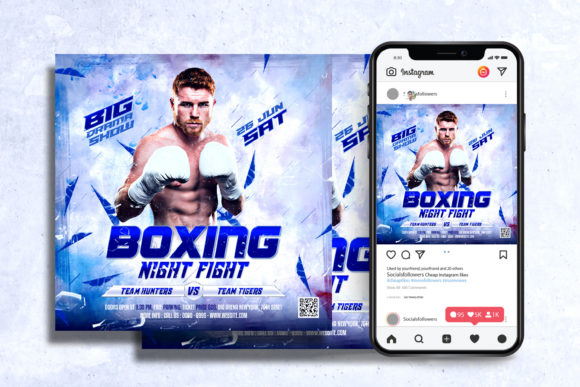
In the high-stakes world of combat sports promotion, clarity and visual impact are not merely aesthetic choices; they are fundamental components of your operational strategy. Whether you are organizing a local amateur bout, promoting a professional championship, or managing a gym’s open house event, the way you communicate details to your audience determines attendance, engagement, and ultimately, revenue. Utilizing a professionally designed Boxing Flyer and Social Media Post template allows promoters and marketers to bypass the initial design hurdles and focus on strategic messaging. This approach ensures that your promotional materials are not only visually compelling but also technically sound for both print and digital distribution.
The Strategic Value of Integrated Promotional Assets
Modern marketing requires a cohesive presence across multiple channels. A potential attendee might first see your event on Instagram, then look for a physical poster at a local gym, and finally check Facebook for ticket details. If the visual identity varies significantly across these touchpoints, you dilute brand recognition and create cognitive friction for the consumer. A unified Boxing Flyer and Social Media Post template solves this problem by providing a consistent visual language.
By using a single source file that adapts to both square social media formats and standard print dimensions, you ensure that typography, color grading, and imagery remain consistent. This consistency builds trust. When your audience sees the same high-quality design across platforms, they perceive the event as professional and well-organized. This perception is crucial in the boxing industry, where the perceived quality of the promotion often reflects on the perceived quality of the fighters and the production value of the event itself.
Technical Precision: Why 300 DPI and CMYK Matter
One of the most common mistakes in event promotion is neglecting the technical specifications of print media. Many creators design solely for screens, resulting in pixelated or color-distorted printed materials. The template in question addresses this by offering files in CMYK 300 DPI for print readiness. CMYK (Cyan, Magenta, Yellow, Key/Black) is the color model used by commercial printers, whereas RGB (Red, Green, Blue) is used for digital screens.
When you convert an RGB image to CMYK without proper preparation, colors can shift dramatically—vibrant neon greens may turn muddy, and deep blues may lose saturation. By starting with a template pre-configured for CMYK, you eliminate this risk. Furthermore, the 300 DPI (dots per inch) resolution ensures that text remains crisp and images retain their detail when printed on large formats. This technical foresight prevents costly reprints and ensures that your physical flyers command attention on bulletin boards and in handouts.
Conversely, the inclusion of RGB 300 DPI files ensures that your social media posts look sharp on high-resolution mobile devices. While web standards often cite 72 DPI, modern retina displays benefit from higher resolution assets. Having both versions ready in one package streamlines your workflow, allowing you to deploy campaigns faster without needing separate design processes for online and offline channels.
Customization and Brand Alignment
A template is only as useful as its adaptability. The provided Boxing Flyer and Social Media Post package includes fully editable PSD files compatible with Adobe Photoshop CC. This level of accessibility is vital for marketers who need to align the design with specific brand guidelines. You are not locked into a rigid structure; instead, you have control over every element.
- Typography: Change fonts to match your gym’s branding or the specific tone of the fight card. Aggressive, bold fonts may suit a heavyweight title fight, while cleaner, modern typefaces might better suit a fitness-oriented boxing seminar.
- Color Grading: Adjust the RCB color settings to align with your sponsor’s logos or your organization’s primary palette. Consistent color usage reinforces brand recall.
- Layout Flexibility: With all main elements editable, you can rearrange fighter photos, adjust ticket pricing visibility, or highlight specific sponsors based on their contribution levels.
It is important to note that while the template provides the structure, the content you insert drives the conversion. High-quality photography of the fighters is essential. Since the template does not include image models, you must source professional headshots or action shots. Blurry or poorly lit photos will undermine the professional feel of the template, regardless of how well-designed the layout is. Invest in good photography; it is the highest-leverage investment you can make in your promotional material.
Operational Efficiency and Time Management
For small business owners, freelancers, and independent promoters, time is a scarce resource. Designing a flyer from scratch can take hours of trial and error, especially if you are not a professional graphic designer. By utilizing a pre-built Boxing Flyer and Social Media Post template, you reduce this time investment significantly. The template comes with a 0.25 bleed area, which is a critical print specification that ensures no white edges appear if the cutter shifts slightly during production.
Understanding these technical details beforehand prevents last-minute panic. When you download a package that includes a "Read Me" file and clearly labeled PSDs, you are buying more than just a design; you are buying peace of mind. You can focus your energy on ticket sales, fighter coordination, and venue logistics rather than worrying about whether your margins are correct.
Strategic Deployment: When and How to Use
Having the asset is only half the battle; deploying it strategically is the other. Consider the following planning tips to maximize the impact of your promotional materials:
- Phase 1: Teaser Campaign. Use the social media post variant to release a "save the date" or a fighter announcement without revealing all details. Create mystery and anticipation.
- Phase 2: Full Launch. Release the full flyer with ticket links, fight cards, and venue details. Ensure the print flyers are distributed in high-traffic areas such as gyms, sports bars, and community centers two weeks prior to the event.
- Phase 3: Reminder and Urgency. Reuse the social media assets with updated text overlays like "Only 50 Tickets Left" or "Fight Week." The consistent visual base allows the audience to instantly recognize the event, while the new text creates urgency.
This phased approach leverages the versatility of the template. Because the file is editable, you can quickly create variations for different stages of the marketing funnel without redesigning the entire composition.
Risks of Generic Implementation
While templates offer efficiency, they carry the risk of genericism if used without thoughtful customization. If you simply swap out the text and leave the default stock imagery or color schemes, your event may look indistinguishable from countless others. To avoid this, you must inject your unique brand identity into the template.
Furthermore, relying on a template without understanding your audience can lead to misaligned messaging. A template designed for a gritty, underground fight club may not resonate with a family-friendly charity boxing event. Always assess whether the visual tone of the template matches the ethos of your event. If necessary, adjust the contrast, saturation, and font choices to better reflect the atmosphere you wish to create.
Another risk is neglecting the call to action (CTA). A beautiful flyer that fails to clearly state how to buy tickets is ineffective. Ensure that your QR codes, website URLs, or phone numbers are prominent and legible. In the digital version, ensure that links are clickable if distributed as a PDF, or clearly displayed if posted as an image on social media.
Long-Term Branding and Asset Management
Using a consistent template series for multiple events can help build a recognizable brand for your promotion company. Over time, your audience will associate the specific layout, font choices, and color grading with your organization. This brand equity makes it easier to sell tickets for future events because the trust has already been established.
Keep your PSD files organized. Archive each event’s final design so you can refer back to what worked well. Did a certain color scheme generate more clicks? Did a particular layout result in higher print engagement? By treating your Boxing Flyer and Social Media Post templates as part of a larger data-driven marketing strategy, you can continuously refine your approach.
In conclusion, a high-quality, editable template is a powerful tool in the promoter’s arsenal. It bridges the gap between professional design standards and operational efficiency. By understanding the technical requirements of print and digital media, customizing the assets to fit your brand, and deploying them with a clear strategic plan, you can enhance your event’s visibility and drive better results. The key lies not just in downloading the file, but in using it with intention, precision, and a deep understanding of your audience’s needs.